
Background
In January 2026, with the use of peer researchers, the INIFIRES research team conducted a mixed-methods study involving a cross-sectional survey (n= 3089 with 1520 males and 1569 females), focus-group discussion (n=X), in-depth interviews (n=X) and X interviews with key informants from non-governmental organisations and government institutions. The project aimed to contribute to interventions that promote positive and healthy relationships among young people.
As such, data from the study informed game conceptualisation. The game developer presented the concept art for the game to young people to gain their input and feedback through a workshop. The methodology for the workshop involved group work, presentations and open discussions.
Involvement of young people in game conceptualisation
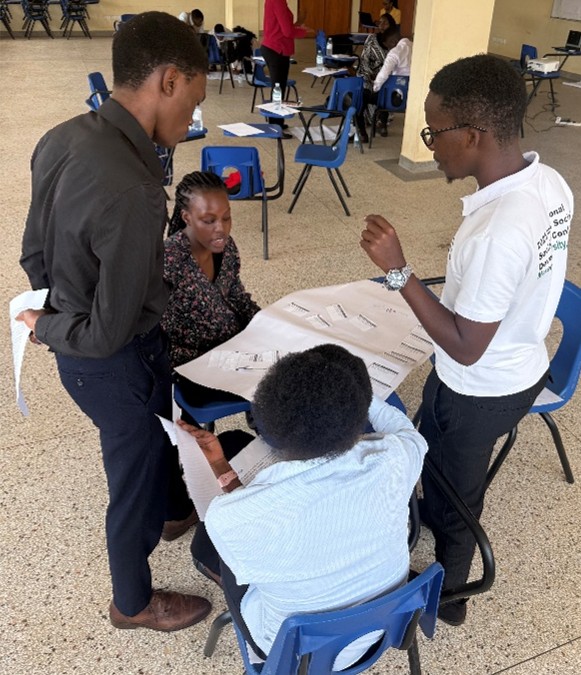
Young people aged 18-24 years were involved in a co-design workshop from 6th -7th July 2026. These involved 11 university students (5 females & 6 males) from Makerere University and 10 community youths (5 females & 5 males) from Nansana Division, Wakiso District. Each group was engaged on a different day. Some university students had participated as peer researchers while some as participants in the focus groups. Also, some community youths participated as respondents in the survey during the data collection phase. Their involvement at the game conceptualisation phase made them excited about the process.
Different endings for the two stories
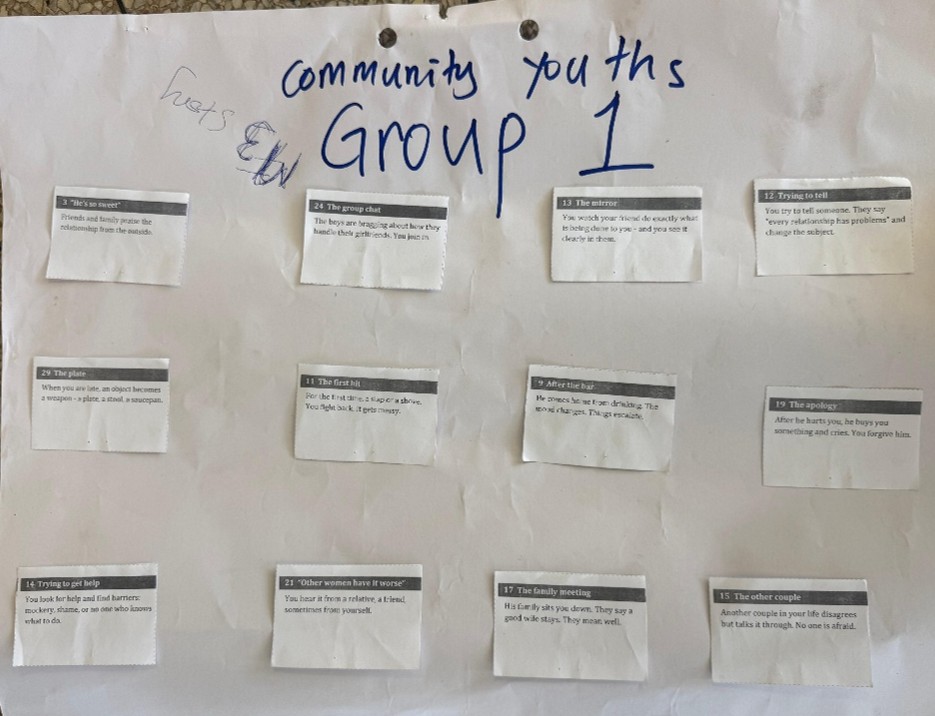
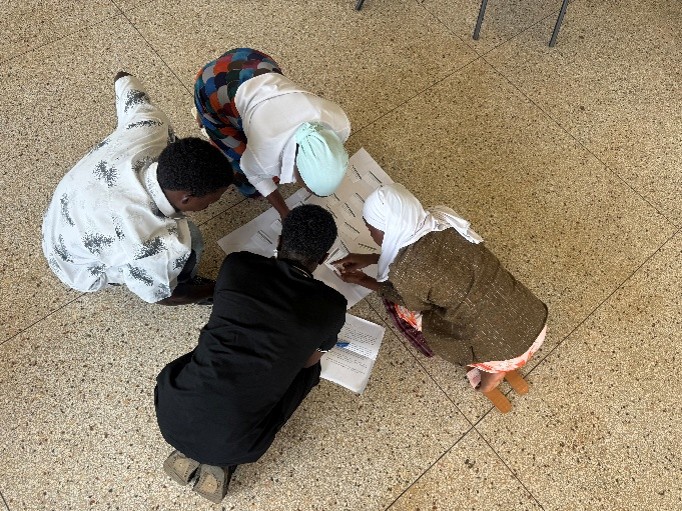
During the workshop, each category of participants was divided into 3 groups composed of 3-4 participants. Each group was given moment cards/deck (30 cards). Two stories F1 and M3 were read at different intervals. For each story, participants were given 20-25 minutes to review the story. Each group picked about 12 cards and mapped out a story and how it played out. This was followed with ten minutes’ explanation of the events in their story and discussing how the story ended. For instance, from F1 story, there was one exit, and it is partial. The fourth peaceful path was produced by exactly one group, and they were university students. Community young people produced no positive ending at all.
Likes, dislikes and what to change about the game
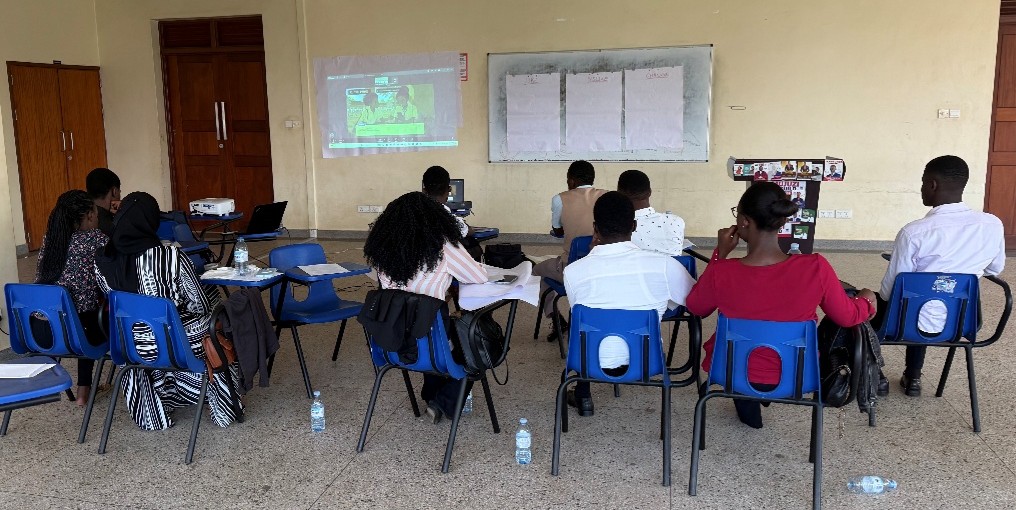
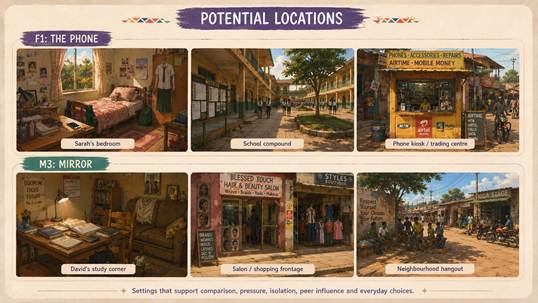
The game developer made a presentation about the prosocial mobile/browser game regarding the concept art and gameplay mechanics. The concept art rotated around thematic areas of the environments, potential locations, playable phone-SMS concepts, red flag mechanics, character exploration in relation to appearance, skin tone and clothing. Participants were supposed to watch and listen as they noted what they liked, disliked and areas for change as follows.

What is working (Likes)
- They liked environments and art style in the game.
- Authenticity: “the graphics show the real community”.
- African colour and texture came out clearly.
- Ugandan trees and landscape were visible.
- Clothing, and clear school / home differentiation.
- Attention to detail in shops and interiors was applauded.
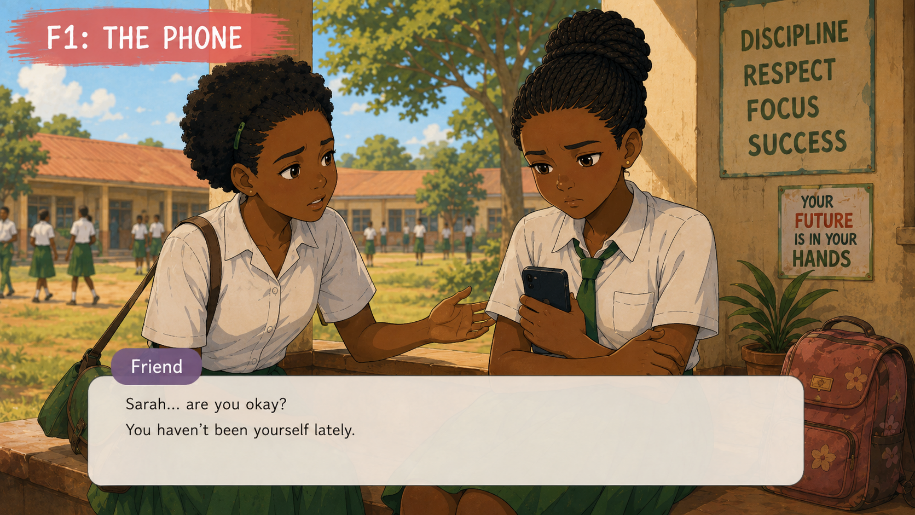
- Character facial expressions (Sarah’s specifically noted) came out clearly.
- Signs and posters in the school environment were visible.

Blockers and conflicts (Dislikes)
1. Smartphones are not allowed in schools
- Only international schools permit them. This is where most relationships form, and F1’s central mechanic is the phone.
- Fixes from the room: restrict phone use to outside school hours, or make the girlfriend a student too.
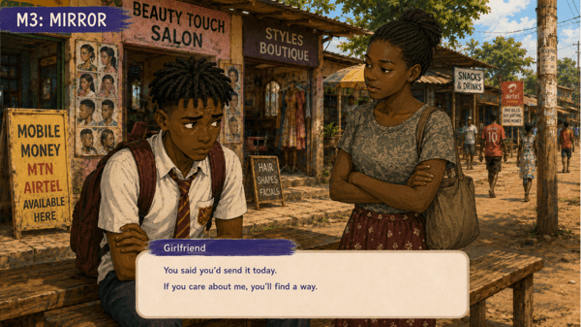
2. M3 girlfriend design is wrong
- She should look older, higher class, flashier, “way out of his league”, and not in the clothes of a much older woman.
- Straight redesign.
3. Hair is contested
- David’s hair called “too Rasta” independently on both days, the single most repeated criticism. Day 1 asked for braids. Day 2 said no braids for schoolgirls, neat and trimmed only.
- Eric and Esther to provide reference images of typical Ugandan hairstyles in the age group. Safe direction is neat / short for school scenes.
4. Skin tone
- David “too dark, avoid generalising”. Boys’ tones too similar and need differentiation. Day 1 also produced “beautiful girl = brown not black”.
- Handle carefully

Areas to fix
- Re-design & create new concepts for characters based on reference images.
- Obtain references & create new hairstyles for characters.
- SMS: use informal shorthand, emojis and stickers, emojis in contact names.
- Uniforms: neckties need long sleeves, add badges, no necklaces, no pins.
- Sarah’s room: add a second bed, make it more feminine (mirror, shoes, bag) since she records videos there.
- David’s room: Make it messier, add football shirt and trainers.
- Interiors read as congested; hangout needs a food court.
- Add animals and cars to environments: “show the beauty of Africa”.
- Make gift-giving visually explicit: a boxed phone.
- Body size variety in characters.
- Replace red flags with red cards or a red triangle, which reads as danger in context.
- Show homework at home to explain where students are out of school hours.
Qualities of a healthy relationship
From open discussions, participants highlighted key themes which the game should communicate about healthy relationships as reflected in the figure below.

Conclusion
The co-design workshop led to the involvement of young people in game conceptualization which is a critical step in developing a culturally and age appropriate prosocial digital game that will be playable on mobile phones for young people and their supporters (informal and formal) to prevent and/or address the impacts of IPV for positive and healthy relationships.

PROMOTING POSITVE AND HEALTHY RELATIONSHIPS AMONG YOUNG PEOPLE!


Leave a Reply